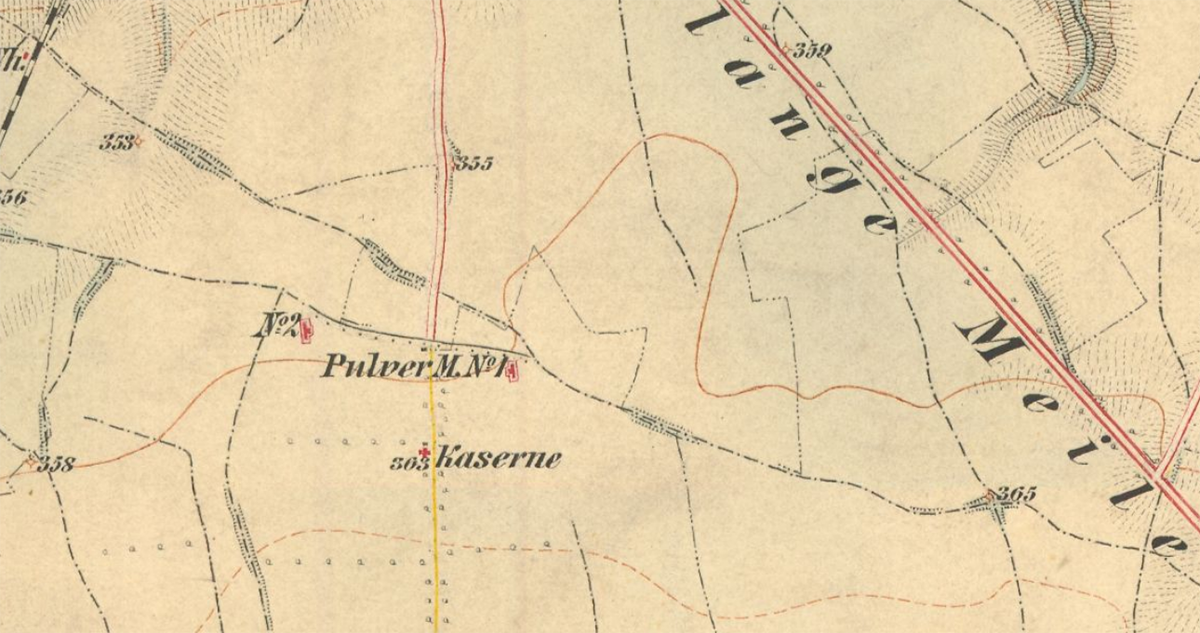
HOSTIVICE – This is the story of how soldiers from the barracks were pilfering the ammunition depot, and how it all came to light thanks to a cesspit explosion in March 1921. But first, a few words of introduction: Prague once kept its powder magazine in the Hvězda Summer Palace, which gradually proved to be a significant risk; in the 1870s it was therefore decided to relocate it. A sparsely populated area near the road from Kněževes to Hostivice, close to the imperial road known as the Dlouhá míle (Long Mile), was chosen as a suitable site. Prague Airport now occupies that location — though that is not entirely precise, and the details will follow in the next instalment. But back to the powder magazine: on the map of the period (3rd Military Survey, 1877–1880) you can see two powder magazine structures (Pulver M. No. 1 and No. 2), with the barracks drawn below them.
So what happened in 1921? On 16 March 1921 at 14:30, the cesspit used for disposing of explosive-production waste exploded. Since this was known to be dangerous, the cesspit was kept constantly flooded with water — but one day it dried out, and some soldier apparently tossed a cigarette butt into it. The result was an explosion that injured seven soldiers and caused material damage.
The investigation commission that arrived on site discovered, among other things, that ammunition had been systematically stolen from the powder magazine. The weekly Čech commented on this rather pointedly:
"The entire ammunition store there was looted and sold off by the very soldiers assigned to guard it, and in a short time. And when Hostivice had been stripped bare like a picked-clean shop, the cesspit for explosive waste suddenly caught fire and there was an explosion. Since both reports — of the theft and of the explosion — reached the public almost simultaneously, a certain connection between them cannot be ruled out. Any layman would immediately ask whether the explosion did not come at just the right moment to cover the tracks and prevent investigation into the missing war materiel. What remains surprising is how such mass theft could have occurred before an officer's eyes, and what kind of supervision failed to notice it sooner, before almost everything had been stolen…"
–to be continued–